News
- Emergent Altermagnetism at Surfaces of Antiferromagnets: Full Symmetry Classification and Material Identification
 Colin Lange, Rodrigo Jaeschke-Ubiergo, Atasi Chakraborty, Xanthe H. Verbeek, Libor Šmejkal, Jairo Sinova, and Alexander Mook Phys. Rev. X 16, 031066 The study demonstrates that … Continued
- 2026 Europhysics Prize honors discovery of altermagnetism
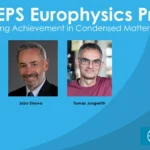 One of Europe’s highest distinctions in condensed matter physics has been awarded for a discovery that is reshaping our understanding of magnetism: The 2026 Europhysics … Continued
Please email us with any updates regarding your team or project that you wish to share with your SPP 2558 program peers. We will publish the most recent information promptly.
The Senate of the Deutsche Forschungsgemeinschaft (DFG, German Research Foundation) has decided to establish a new Priority Programme “Unconventional Magnetism: Beyond the S-Wave Magnetism Paradigm” (SPP 2558). The programme is designed to run for six years. The present call invites proposals for the first three-year funding period.
The main objective of this Priority Programme is fundamental research on unconventional compensated magnets. This programme builds on the recent discovery of altermagnetism and the development of unconventional non-collinear antiferromagnets, which opened a first physical pathway to devices that combine both strong spin-polarised currents operating at THz time scales, with the highest possible data storage densities, overcoming the barriers faced by conventional ferromagnetism and antiferromagnetism.
Altermagnets are an emerging class of compensated collinear magnets with d/g/i-wave symmetry in both real space and the electronic band structure. In addition, the odd-parity-wave magnetic counterpart phases, i.e. p-wave, have also been recently recognised in non-collinear magnetic systems. These new unconventional magnets beyond s-wave order allow to expand the known ferromagnets and antiferromagnets paradigms. Their novel properties, the very large variety of material candidates reaching currently more than 400, and the many connections to other areas of condensed matter physics (topological quantum matter, spintronics, optics, neuromorphic computing, multiferroics, strongly correlated systems, twistronics, etc.), make this emergent field of unconventional magnetism a perfect platform for a Priotity Programme.
The priority program SPP2558 is organized in several subtopic research areas:
- Altermagnetic materials
- Noncollinear unconventional magnetic ordered systems
- Ultra-scalable hybrid systems and devices
Different teams will explore these areas of unconventional magnetism focusing on achieving the following milestones:
- Understanding general ground state properties through controlled growth of key material candidates, theory (both model and material specific), characterization, types of time reversal symmetry breaking, unconventional topology, etc.
- Achieving and controlling unconventional magnonics;
- Observe unique signatures in the ultrafast dynamics of unconventional magnets;
- Explore and demonstrated orbital and correlation effects, and instabilities in the different unconventional magnetic phases.
This Priority Programme should further Germanys leading position in this emerging field, given the pioneering role of several German teams in the discovery of altermagnetism and the development of unconventional magnetism in general. The Priority Programme aims to connect the multiple efforts of various Germany-based teams working in a variety of fields of condensed matter, materials science, and engineering, towards the full understanding, control and ultimate functionalisation of unconventional magnetism beyond the s-wave paradigm of ferromagnetism and antiferromagnetism.
| SPP 2558 Unconventional Magnetism: Beyond the s-wave magnetism paradigm | |
|---|---|
| Funding period | since 2026 |
| DFG program | Priority Programmes (Includes listed below Subprojects) |
| Spokesperson | Professor Jairo Sinova Ph.D. Fachbereich Physik, Mathematik und Informatik Institut für Physik JGU |
| DFG subject area | 32 Physics 43 Materials Science and Engineering |
| Project Identifier | Deutsche Forschungsgemeinschaft (DFG) – Project number: 560183302 |
The umbrella of SPP2558 is broader than the funded projects. Projects working on unconventional magnetism but funded from other sources can participate in the SPP2558 network benefits. If you project is not in this list, please contact us.
What is the best option for this section?
An option 1 for short text with method description. Another option 2 presented in table format.
Both options can incluse links on Inctitutions/Bodies that use listes technique and DOI links
An Auger spectrometer is a scientific instrument used by physicists and materials scientists to figure out what tiny layers of atoms are made of on the surface of solid materials. It works by shooting a beam of fast electrons at a sample, which knocks out electrons from the inner shells of the atoms. When outer electrons drop down to fill those empty spots, they spit out extra energy in the form of “Auger electrons,” and the machine measures their specific energy speeds.
Because every chemical element has a unique set of electron energy levels, this machine acts like an atomic fingerprint scanner to identify surface elements. The biggest benefit of Auger spectroscopy is its incredible surface sensitivity and high resolution, allowing scientists to study layers just a few atoms thick. This method is super useful for researching nanotechnology, computer microchips, and new types of materials to make sure they are made correctly.
Links to institutions and\or publication by SPP Participants goes here 
| Technique | What it detects in altermagnets | Who & Where support |
|---|---|---|
| ARPES / soft X-ray ARPES | Directly maps momentum-dependent band splitting and lifted Kramers degeneracy in the electronic structure. Direct | Links to institutions and\or publication by SPP Participants goes here |
| Spin-resolved ARPES (spin-ARPES / SARPES) | Separates spin-up and spin-down branches, directly verifying the spin polarization of the split bands. Direct | Team of XXX, Center for KLMNO  |
| Inelastic neutron scattering | Detects magnon splitting, giving a direct magnonic signature of altermagnetism rather than electronic band splitting. | DOI….. |
| Polarized neutrons | Measures magnon chirality anisotropy and time-reversed domain populations, providing a magnon-based signature of the phase. | Institution 1, Uni 2, Lab A, Group C, |
| XMCD / XPEEM / PEEM imaging | Does not resolve band splitting directly, but reveals broken time-reversal symmetry and domain structure consistent with altermagnetism. | |
| PEEM | Images altermagnetic domains and vortices when combined with XMCD. Domain imaging, not band splitting directly | |
| Magneto-optical Kerr / Voigt / magneto-optical spectroscopy | Probes symmetry-dependent optical responses tied to altermagnetic order; useful as a fingerprint, not a direct band map Indirect, but efficient | |
| Transport measurements | Detect anomalous Hall, nonlinear Hall, spin-to-charge conversion, or spin Hall magnetoresistance consistent with altermagnetic splitting; these are indirect signatures. Indirect | |
Circular-dichroism ARPES (CD-ARPES) | Reveals spin-texture-related contrast and is highlighted as a useful ARPES variant for altermagnets. Supportive / variant of ARPES | |
We are looking to highlight the latest successes from our scientific partners. If you have any recent papers, achievements, or breakthroughs you are proud of and would like to share, let us know the details and we’ll feature them with our community here (in News or in Publications section).
- Colin Lange, Rodrigo Jaeschke-Ubiergo, Atasi Chakraborty, Xanthe H. Verbeek, Libor Šmejkal, Jairo Sinova, and Alexander Mook
Autors: Name 01, Name 02, Name 03, Name 04, Name 05
2020
Autoren: Name 01, Name 02, Name 03, Name 04, Name 05
2020
Autoren: Name 01, Name 02, Name 03, Name 04, Name 05
2020
Autoren: Name 01, Name 02, Name 03, Name 04, Name 05
2020
Autoren: Name 01, Name 02, Name 03, Name 04, Name 05
2020
Autoren: Name 01, Name 02, Name 03, Name 04, Name 05
2020
Autoren: Name 01, Name 02, Name 03, Name 04, Name 05
2020
Dear Participants of SPP 2558, if you would like to report your publications here as part of our Priority Programme, please contact the Coordinators or Data manager.
- PI and Collaborators Retreats (Years 1 & 2):
Exchange of results, foster collaborations, strategic discussions (2 days, ~ 60 participants). - Young Researcher Workshops (Years 1 & 2):
Early-career networking, independent collaboration, external input (3 days, ~30 participants). - International Network Meeting:
Coordination with global programs to strengthen international collaboration (3 days, ~ 50 participants). - Summer School (Year 3):
Training and knowledge transfer via expert lectures (4 days, ~50 participants). - International Conference (Final Year):
Presentation of major results and strengthening global visibility (4 days, ~120 participants).
All talks from SPP workshops, as well as presentations by external speakers at the Young Researcher (PhD) workshops, will be recorded and made available online through the Spin Phenomena Interdisciplinary Center (SPICE)